
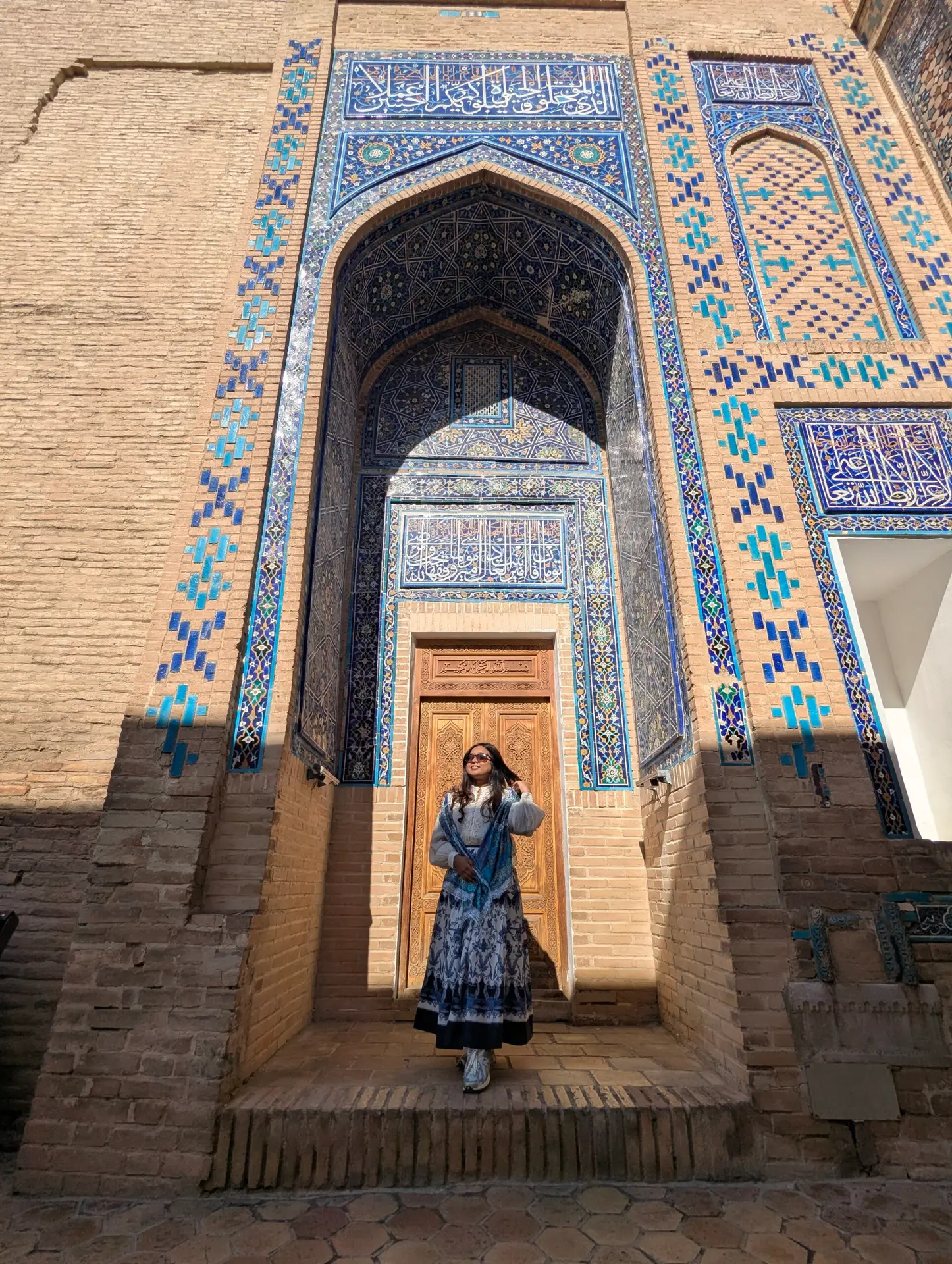
Central Asia · Travel Essay · First Published May 2026
You think you are going somewhere unfamiliar. You are not prepared for how much of it you already know.
Uzbekistan was never in my original plan. But after a forced reroute away from Russia, Central Asia emerged as an answer — and Uzbekistan turned out to be one of the most surprising, beautiful, and historically rich destinations I have ever visited. This is a complete Uzbekistan travel guide for Indian travellers: the visas, the cities, the food, the history, and the honest truth about why this Silk Road country deserves to be at the top of every Indian traveller’s list right now, while it is still blissfully undiscovered.
01 · This Trip Was Never Supposed to Happen
The original plan was Russia. We had everything mapped out — the itinerary, the excitement, the sense of finally going somewhere we had talked about for years. Then the war happened, and our flights were routed through Kuwait and Dubai, and the news coming out of the Middle East made both of those stops feel deeply uncertain. We cancelled. And then we had to think fast.
Central Asia emerged as the answer almost immediately. Safe, politically stable, geographically fascinating, and — crucially for Indian passport holders, who always have to think about visas before we think about anything else — remarkably easy to enter. Kazakhstan is visa-free for Indians for up to 30 days. Uzbekistan requires an e-visa, which I applied for online and received within 48 hours. It was, without exaggeration, the easiest visa I have ever applied for in my life. We booked our flights three weeks before departure. That, for those of us accustomed to planning international trips six months in advance around visa appointment slots, felt almost reckless.
I knew about the Silk Road in the abstract — everyone does. But the current reality of Uzbekistan? Almost nothing. The information available to Indian travellers was surprisingly thin for a country with this much to offer. So I went with an open mind and almost no expectations.
Nothing — nothing — about Uzbekistan matched what I had imagined anyway.
I expected something rougher, more frontier. What I found instead was immaculate streets, grand Soviet-era metro stations in Tashkent decorated like palaces, fast trains that connect ancient cities in hours, and people so genuinely warm that by day three I felt inexplicably at home. The country only fully opened to tourism when President Shavkat Mirziyoyev — who took office in 2016 after the death of the authoritarian Islam Karimov — began dramatically liberalising visa rules and investing in infrastructure. The transformation has been rapid. Uzbekistan ranked among the seven fastest-growing tourism destinations in the world in 2025, according to UN Tourism. And yet right now it is still blissfully uncrowded. We saw mostly Europeans — a surprising number of French and British travellers — and remarkably few Indians, which is unusual for anywhere worth going these days.
This window will not stay open indefinitely.
Uzbekistan Visa for Indian Travellers
Indian passport holders need an e-visa for Uzbekistan — apply at evisa.gov.uz, typically processed within 2–3 days, straightforward and inexpensive. Kazakhstan is visa-free for up to 30 days. Direct flights operate from Delhi and Mumbai to Tashkent with Uzbekistan Airways and IndiGo. Best time to visit Uzbekistan: April–May is the sweet spot — spring weather, fruit trees in bloom, manageable crowds. September–October is equally good. Avoid July–August when the desert cities are genuinely brutal.
02 · Cleanliness Has Nothing to Do With Wealth
The cleanliness hit me first, and I will be honest about why it struck me as hard as it did. India has a reputation in this regard, and I will not be defensive about it — it bothers me too. I feel we have gotten worse, not better. And so arriving in a country whose GDP per capita is not dramatically higher than India’s and finding streets you could genuinely eat off was a reckoning I had not anticipated.
Uzbekistan dismantled a belief I had been carrying without quite realising it: that cleanliness is a function of wealth. It is not. It is culture. It is what a society collectively decides to value and enforce and take pride in. The Uzbeks are meticulous about their public spaces in a way that felt, to me, deeply intentional — not the result of municipal resources but of a shared civic attitude. Tashkent in particular is green, wide-pavemened, tree-canopied, and walkable in a way that most Indian cities simply are not. It made me feel something uncomfortable and necessary: a kind of civic envy, and a renewed frustration with our own relationship to shared space.
“Cleanliness, I now believe, has nothing to do with how rich or poor a place is. It is purely culture — what a society decides to care about.”
I met a solo traveller from France in Bukhara and another from Hong Kong, both of whom said they were longing to visit India. I always tell people who want to travel to India: plan very carefully, and if you are a solo female traveller, consider starting with the southern states rather than the north. That I feel more comfortable travelling solo abroad than in my own country is something I carry with me on every trip — a quiet discomfort that sharpens my appreciation for places that get the basics of safety and dignity right.
Uzbekistan got them right. We were never once concerned, in any city, at any hour.
03 · The Man Who Built the Taj Mahal Was Born Here
Before you book a single train ticket, sit with this for a moment: the man who founded the Mughal Empire — and thus set in motion the chain of rulers who would eventually build the Taj Mahal, the Red Fort, and Fatehpur Sikri — was born in Andijan, in present-day Uzbekistan. Zahiruddin Muhammad Babur came into this world in 1483 in a fertile valley in the Fergana region, not far from Tashkent, and while Indians tend to relate to Babur primarily through the contested politics of history, Uzbekistan sees him as something else entirely: a poet, a diarist, a national hero. February 14th is declared Babur Day. Parks, monuments, and a whole international foundation are dedicated to his memory.
Babur’s great-great-great-grandfather was Amir Timur — Tamerlane — whose mausoleum in Samarkand, the Gur-e-Amir, is the direct architectural ancestor of Humayun’s Tomb in Delhi, which in turn inspired the Taj Mahal. Stand inside the Gur-e-Amir and the geometry is almost eerily recognisable. You have seen this proportional logic before; you were just looking at it from the other end of history.
“The Bibi Khanum Mosque in Samarkand was decorated with papier mâché made by Kashmiri artisans — craftsmen brought back by Timur from his sack of Delhi in 1398.”
This detail stopped me cold when I first read it. And then, walking through the bazaars of Bukhara, I kept noticing the embroidery — the patterns on the suzani cloth, the motifs on the ceramics — and thinking: I have seen this. We call it Kashmiri embroidery. But standing here, I found myself genuinely wondering: who taught whom? Did the artisans travel from Kashmir to Central Asia, or did the patterns flow the other way, down through the passes, into the valley? The Silk Road was never a one-way street. Most of what we claim as distinctly Indian was, at some point, in transit.
04 · The Language of Home, Spoken by Strangers
You will be walking through a bazaar in Bukhara, and a word will reach you from a conversation between two strangers — and you will stop. Mehmon. Guest. You know that word. In Hindi-Urdu, it is mehman. Kitob is Uzbek for book; in Hindi-Urdu, kitab. Muborak means blessed — the same word deployed across India at Eid and Diwali. The phonetic overlap between Uzbek, Persian, and the Indo-Persian vocabulary that saturates North Indian languages creates a sensation that is genuinely disorienting — not the disorientation of being lost, but of being almost found.
And then there is the moment I did not expect: someone handed me tea in a small ceramic bowl, and called it a pyala. The Hindi word. The exact same word. I am not a tea drinker — I should say that clearly, because what follows means more if you know it. I deliberately ordered tea every single day in Uzbekistan, not out of politeness but because I genuinely wanted more of it. It was that good. They give you a whole teapot, never a cup, in small ceramic bowls rather than mugs. The tea is green, fragrant, completely milk-free, and brewed with a flavour and aroma that feels like experiencing the culture directly, without translation.
The food vocabulary deepens the disorientation pleasantly. The samsa — Uzbekistan’s beloved baked pastry filled with spiced lamb, onion, and fat — is, unmistakably, our samosa, cooked in a tandir (our tandoor). Choy is chai. Non is naan. The everyday grammar of eating and hospitality, the Persian connective tissue shared between the Subcontinent and Central Asia, reveals itself constantly. It feels less like discovery and more like recognition.
05 · The Food Is Better Than Anyone Tells You
We are not heavy meat eaters. Red meat especially is not a regular part of our diet. I want to be honest about this because I know many Indian travellers approach Central Asian cuisine with a certain resigned pragmatism — spice-deprived, meat-heavy, difficult for vegetarians. This is a half-truth at best, and I did not let it stop me from tasting everything.
Shashlik: skewers of lamb or beef, charred over coals, eaten standing up at a market stall with nothing but bread and a gust of smoke. Samsa from clay ovens, the pastry shattering when you bite it. Plov — the national dish, a slow-cooked rice pilaf with lamb, carrots, chickpeas, raisins, and whole heads of garlic — which I would describe as biryani’s quieter, older Central Asian cousin: less fiery, more elemental, tasting of steppe and patience rather than Mughal excess. The plov in Bukhara is notably different from Tashkent’s version — rice boiled separately first, lighter, more aromatic — and Uzbeks are serious about this distinction in the way Indians are serious about whose biryani is superior.
In the local markets I tried curd balls — hard, salty, intensely dried — which taste ancient and abrupt and completely unlike anything in our culinary vocabulary. They are, in fact, ancient: these were the travel food of Silk Road traders, a compact source of protein that lasted for weeks on the road. Eating one in a Bukhara bazaar, knowing this, makes it taste like history. I drank pomegranate juice pressed in front of me, the colour of old garnets. The bread — non, pulled into great oval rounds and dimpled before baking against clay oven walls — became a daily ritual.
One thing that will genuinely surprise you: the Korean restaurants. Central Asia has a significant Korean population, the descendants of Koryo-saram — ethnic Koreans forcibly deported to Central Asia by Stalin in 1937. Over 170,000 people were relocated, many to Uzbekistan and Kazakhstan, in a matter of weeks. Their descendants have been here ever since, and their cuisine — Korean-Central Asian fusion, essentially — has become part of the local food landscape in ways that are both unexpected and delicious.
For Vegetarians Travelling Uzbekistan
You will not struggle. Pumpkin samsa, fresh bazaar salads heavy with tomatoes and dill, manti with pumpkin filling, lagman noodle soup — options exist everywhere. The bazaars are extraordinary for fruit and dried goods alone: mounds of apricots, figs, walnuts, pistachios, mulberries, and the fabled melons of Fergana that Babur himself wrote about with homesick longing.
For the Indian palate: Indian restaurants exist in Tashkent, catering to the community of over 12,000 Indian students studying medicine at Uzbek universities. They exist if you need a spice reset. But resist the urge too readily — you will regret eating dal makhani when shashlik was ten metres away.
06 · Tashkent Is Not What Any of the Brochures Suggest
Most travellers treat Tashkent as a layover city — the necessary entry point before the Silk Road cities that actually feature in the photographs. This is a significant error. Tashkent is one of the most architecturally singular capitals in Asia, and almost nobody talks about it.
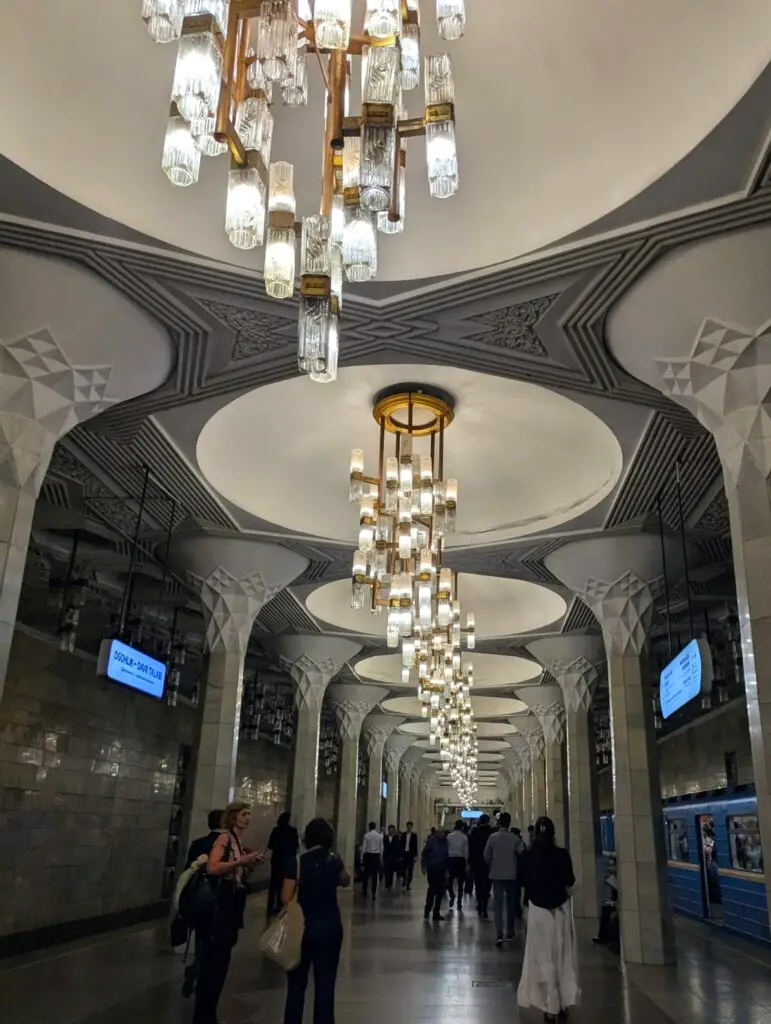
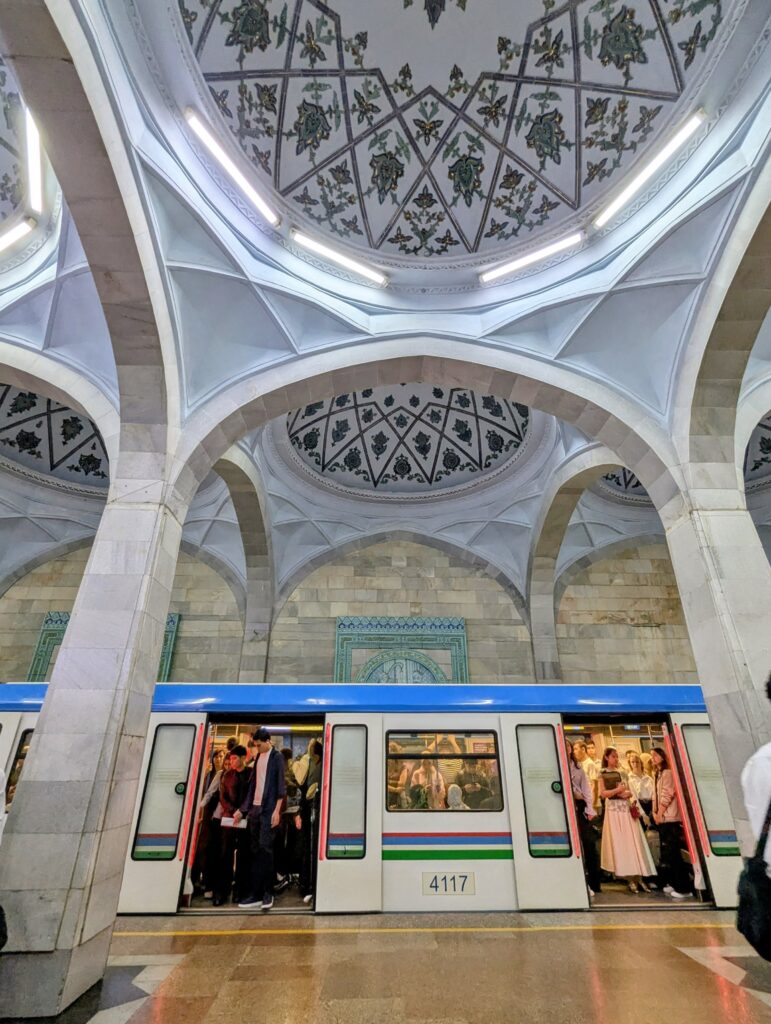
In 1966, a devastating earthquake levelled much of the old city. The Soviet Union saw in the rubble an opportunity: Tashkent would be rebuilt as a model of socialist modernism, a showcase of what the USSR could offer Central Asia. What emerged was a city unlike any other — wide, tree-lined boulevards, brutalist civic buildings softened with geometric Islamic ornamentation, enormous mosaic murals on apartment blocks, and a metro system so ornate that each station reads as a separate art installation. The Tashkent Metro, opened in 1977 and the first underground railway in Central Asia, has stations with soaring ceilings in hand-cut ceramic tile, geometric stalactite work, and chandeliers that would not be out of place in a Rajput palace. In 2024, Tashkent’s modernist architecture was formally nominated for UNESCO World Heritage status.
One more thing about Tashkent: almost every car is a Chevrolet. This is not a coincidence. The previous president, Islam Karimov, negotiated an exclusive deal with General Motors in the 1990s to produce cars locally — a deal that shaped the entire automotive culture of the country for decades. Only recently, with Chinese manufacturers entering the market, has the Chevrolet monopoly begun to loosen. It is the kind of detail that makes you realise how much a single political decision can shape the texture of daily life in a place.
07 · The Speed of Getting Somewhere Ancient
There is something almost surreal about boarding a high-speed train in a modern capital, watching flat desert landscape scroll past at 220 kilometres per hour, and stepping off two hours later in a city that was a centre of civilisation five hundred years before the Mughals arrived in India.
The Afrosiyob connects Tashkent to Samarkand in approximately two hours, and continues to Bukhara in around three and a half. It is efficient, comfortable, quiet, and creates a remarkable cognitive dissonance. Book these trains well in advance — they sell out. We used 12go, which was easy and reliable. Within cities, Yandex (the Russian equivalent of Uber) is available everywhere, arrives in two to five minutes, and is very affordable. At airports and train stations, ignore the taxi drivers who approach aggressively — they can be very persistent and the prices are inflated. Yandex will solve all of this without any negotiation or uncertainty.
Getting Around Uzbekistan: The Essentials
Book Afrosiyob trains in advance on 12go.asia — they sell out, especially on weekends and holidays. For local transport, use Yandex Taxi exclusively; it’s safe, metered, and far cheaper than negotiating with private drivers. Google Translate handles most language situations comfortably. The main language barrier is with older residents; younger Uzbeks often have functional English.
08 · Samarkand Will Change How You See Blue
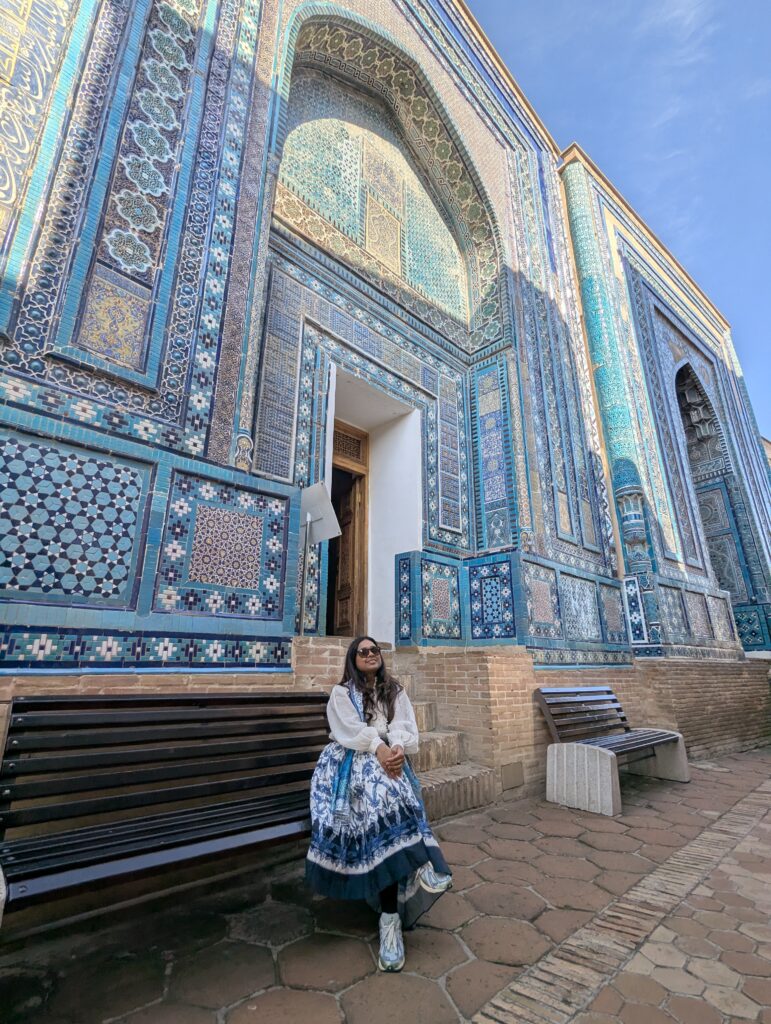
This is the thing nobody tells you and everyone eventually says. You will not be able to look at the colour blue the same way after Samarkand. The tilework of the Timurid monuments — the Registan, the Shah-i-Zinda necropolis, the Bibi Khanum mosque, the Gur-e-Amir — deploys cobalt, turquoise, and lapis in combinations of such precision and density that the eye needs time to calibrate. These are not decorative flourishes. They are cosmological arguments, made in ceramic, about the relationship between earth and heaven.
The Registan — three madrasas arranged around a central plaza, their facades a dense vocabulary of mosaic tilework — has a scale and coherence that photographs fail entirely to convey. Indians who have grown up visiting Mughal monuments will recognise the aesthetic DNA immediately: the honeycomb muqarnas, the calligraphic borders, the play of colour against unadorned brick. But the Registan is the mother of those ideas, not their echo.
I will say this clearly: do a walking tour in every city. We book ours through GuruWalks or GetYourGuide, and the Uzbekistan guides on GuruWalks were particularly excellent — knowledgeable, passionate, and tip-based, so you pay what you feel the experience was worth at the end. A good local guide will show you layers of culture, architecture, and history that you would never find on your own, and in a country this layered, that matters enormously.
One more practical note that made a genuine difference: learn a few words of Russian, or at least learn to read Cyrillic. Uzbek is the official language, but Russian is widely understood, especially among older residents, and the street signs are often in Cyrillic. You do not need fluency — spasiba (thank you) and priviet (hello) will do. The warmth that comes back when locals realise you have made any effort at all is something Google Translate cannot replicate.
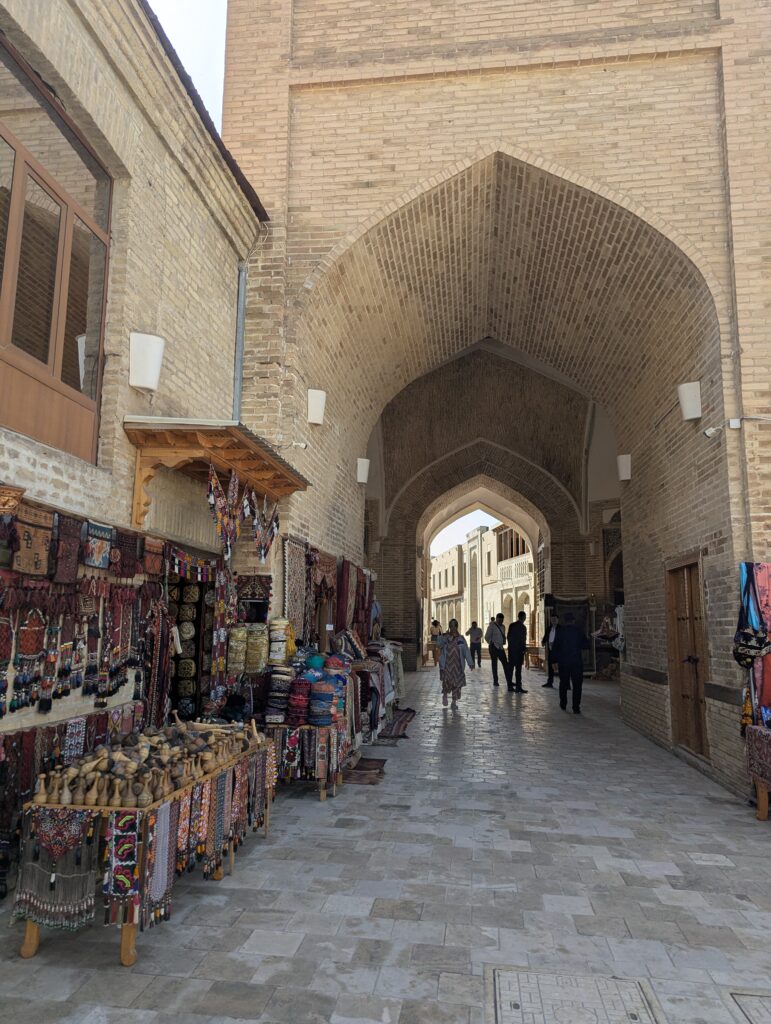
09 · Bukhara Is Where You Will Lose Track of Time
Between Samarkand and Bukhara, I am not neutral: Bukhara won. By a significant margin.
Samarkand is monumental — you go there to be awed, and you are. But Bukhara is a city you inhabit. Its old town is a maze of alleys, functioning caravanserais, hammams still in use, madrasas still teaching, and a density of architectural texture that rewards slow walking and deliberate getting lost. The Ark — the ancient fortress at the city’s heart, built in pale mud-brick that glows amber in the late afternoon light — has a quiet majesty that the more photographed monuments sometimes lack. The Kalon Minaret, one of the few structures in Central Asia that Genghis Khan ordered preserved rather than destroyed, rises above the old city with an authority that is hard to argue with.
On our last evening in Bukhara, we climbed to a rooftop terrace restaurant near the Kalon. The sun was going down over the old city, and the minarets and domes were catching the last of the light, and they handed us thick blankets because it was chilly, and we sat there with our tea — a whole pot, as always, in small ceramic bowls — and I thought: this is it. This is the feeling you travel for. It had an Arabian Nights quality that I am not sure any photograph will ever quite capture. Bukhara felt like how I imagine Morocco to feel — the tiny doors of the old haveli-like structures reminded me of intricate doorways in old Indian cities, the painted walls echoed patterns I had seen in Rajasthan — but with its own proud, specific identity.
One note: Bukhara is noticeably more expensive than Samarkand. Budget accordingly, and do not be surprised if the prices in the tourist bazaars feel steep relative to the rest of the country.
“On a rooftop above the old city, wrapped in a blanket with a pot of tea, watching the minarets catch the last light — that is the feeling you travel for.”
10 · The Hospitality Will Unsettle You, Pleasantly
Uzbek hospitality is not a talking point in a brochure. It is a structuring principle of daily life. Mehmon otaning o’g’lidan aziz — the guest is more dear than one’s own father — is a proverb that Uzbeks quote with what appears to be genuine intention. The ritual of tea, the unhurriedness of a meal, the instinct to share, the pride in presenting what one has — all of this will feel intensely familiar to an Indian traveller, yet somehow more formalised, more ceremonially expressed.
What will be less familiar is how safe and low-pressure the interaction feels. The country has worked hard at reforming its tourism infrastructure since the late 2010s, and the result is a destination where the approach of a local is far more likely to be curiosity than commerce. Uzbekistan is a secular government in a Muslim-majority country, and the form of Islam practised here — shaped by decades of Soviet secularism and the region’s ancient Sufi traditions — has a texture distinctly its own. Alcohol is widely available. Women travel without restriction.
Is Uzbekistan safe for women? As a woman travelling here, I felt completely safe at all times, in every city, at every hour. That is not a small thing, and I do not say it casually.
11 · The Piece of Indian History Nobody Talks About
In January 1966, Indian Prime Minister Lal Bahadur Shastri travelled to Tashkent to sign a peace declaration with Pakistan, ending the 1965 war. He died here in the early hours of the morning after the signing — officially of a heart attack, though questions have swirled ever since. He is the only Indian Prime Minister to have died on foreign soil, and he died in Uzbekistan.
There is a memorial to Shastri in Tashkent — modest, not heavily visited — which carries a particular weight for Indian travellers who encounter it unexpectedly. It is one of several moments in Uzbekistan where Indian history, which you thought you left behind at the departure gate, resurfaces with quiet insistence.
12 · You Will Leave Feeling Strangely Rearranged
Most destinations offer you the experience of going somewhere. Uzbekistan offers Indian travellers something rarer: the experience of understanding where you came from.
The architectural DNA of the great Mughal monuments, the Persian vocabulary threaded through Hindi and Urdu, the sambosa-to-samosa migration of a recipe across mountain ranges, the embroidery patterns we call Kashmiri that may have originated here — all of it leads back to this landlocked country in the middle of Asia that most Indians couldn’t locate on a map before they started planning the trip. I found myself thinking about this constantly: how permeable borders always were, how long the conversations between civilisations lasted, how much of what feels distinctly Indian was once in transit across the Silk Road.
I will go back. I am certain of it. We did not make it to Khiva this time — the desert city described as the most perfectly preserved of the three UNESCO sites, walled and almost theatrical in its completeness. And somewhere beyond that, the remnants of the Aral Sea: once one of the largest lakes in the world, now a desert scattered with the rusted hulls of ships stranded in sand — one of the most quietly devastating landscapes on earth, and a place I feel I need to see.
Babur, who never returned to Uzbekistan after he conquered India, spent the last years of his life writing about it — its rivers, its melons, its mountain air — with the longing of a man who had everything except the place he most wanted to be. Uzbekistan is very good at making you feel something like that. The difference is you can go back.
We will.
Uzbekistan Travel Quick Guide for Indians
Visa: E-visa required, apply at evisa.gov.uz — processed in 2–3 days, approximately $20–25
Best time to visit: April–May or September–October
Flights: Direct from Delhi and Mumbai with Uzbekistan Airways and IndiGo
Getting around: Afrosiyob high-speed train between cities (book on 12go.asia); Yandex Taxi within cities
Currency: Uzbekistani Som — carry USD to exchange locally, widely accepted
Safety: Very safe, including for solo women travellers
Language: Uzbek + Russian; younger residents often speak English
Don’t miss: Registan (Samarkand), Kalon Minaret (Bukhara), Tashkent Metro, Shah-i-Zinda necropolis
Planning the itinerary? Read our complete Uzbekistan itinerary for Indian travellers →
A Country That Feels Like Memory
Uzbekistan is not a new discovery. It is a very old one, recently made accessible. Go in April. Book your trains early. Drink all the tea. And go before everyone else figures out what you already know.
